Field guide
Recognizing jade in nature
Composition tells you what the two stones are. It is far less help when you are holding a water-worn cobble wearing an oxidized rind, in a creek, with no bench and no spectrometer.
The checks below are ordered the way they are worth running: the ones that cost nothing first, the ones that mark the stone last, and the laboratory confirmations at the end. None of them is individually conclusive. Together they narrow the field quickly and reliably.
One rule before any of it: do not test on a good face. Scratching, filing and tapping all leave marks. Work on a hidden edge, a broken corner, or a piece you are willing to lose.
Ten checks
Working through a stone
-
Where you are standing
This is the most informative test on the list and it costs nothing. Nephrite is widespread and forms at metasomatic contacts — serpentinite against silica-rich rock, or dolomitic marble — and travels a long way downstream as river float. Jadeite forms only under high-pressure, low-temperature conditions in subduction-zone serpentinite mélange, and is known from roughly two dozen localities on Earth.
If you are not on or downstream of a recognized jadeite belt, a tough green stone is overwhelmingly more likely to be nephrite, serpentine, vesuvianite, hydrogrossular, epidote or amphibolite. Learn the geology of your ground before you learn the tests.
- Nephrite terrain
- Serpentinite belts and dolomitic contacts worldwide; abundant river and glacial float.
- Jadeite terrain
- Subduction mélange only — Myanmar, Guatemala, Japan, Russia, California, the western Alps and a short list besides.
-
Heft
Pick it up. Jadeite is materially denser than nephrite — roughly 3.30 to 3.38 SG against a standard nephrite range of 2.88 to 3.03 — and at the same size it feels dead-heavy in a way that registers immediately once you have handled both.
Two cautions. Heft separates either jade from lighter impostors such as serpentine far more reliably than it separates the two jades from one another. And the ranges are not airtight: exceptionally dark, iron-heavy nephrite has been measured up to 3.405 SG, which lands squarely inside jadeite territory. A heavy black stone is not proof of jadeite.
- Nephrite
- Heavy for a rock, but you can lift a fist-sized piece all day. 2.88–3.03 SG standard.
- Jadeite
- Conspicuously heavier for its size. 3.30–3.38 SG typical.
-
The tap, or ring, test
Suspend the piece — on a string, or balanced across two fingers — and tap it with another stone, a coin or a light hammer. Both jades transmit sound unusually well for rock, because both are built from tightly interlocked crystals with very little pore space. Nephrite in particular gives a long, clear, musical note; its felted fiber network is exceptional at carrying vibration. Prospectors in British Columbia have used a hammer and an ear on boulders for generations.
What the test really excels at is exclusion. Serpentine, quartzite and most impostors give a short dull knock. Polymer-impregnated jade — see the treatment codes below — thuds rather than rings, because the resin damps the stone.
- Nephrite
- A long, low, bell-like ring that sustains.
- Jadeite
- A ring too, generally higher-pitched and shorter.
-
Wet it, then window it
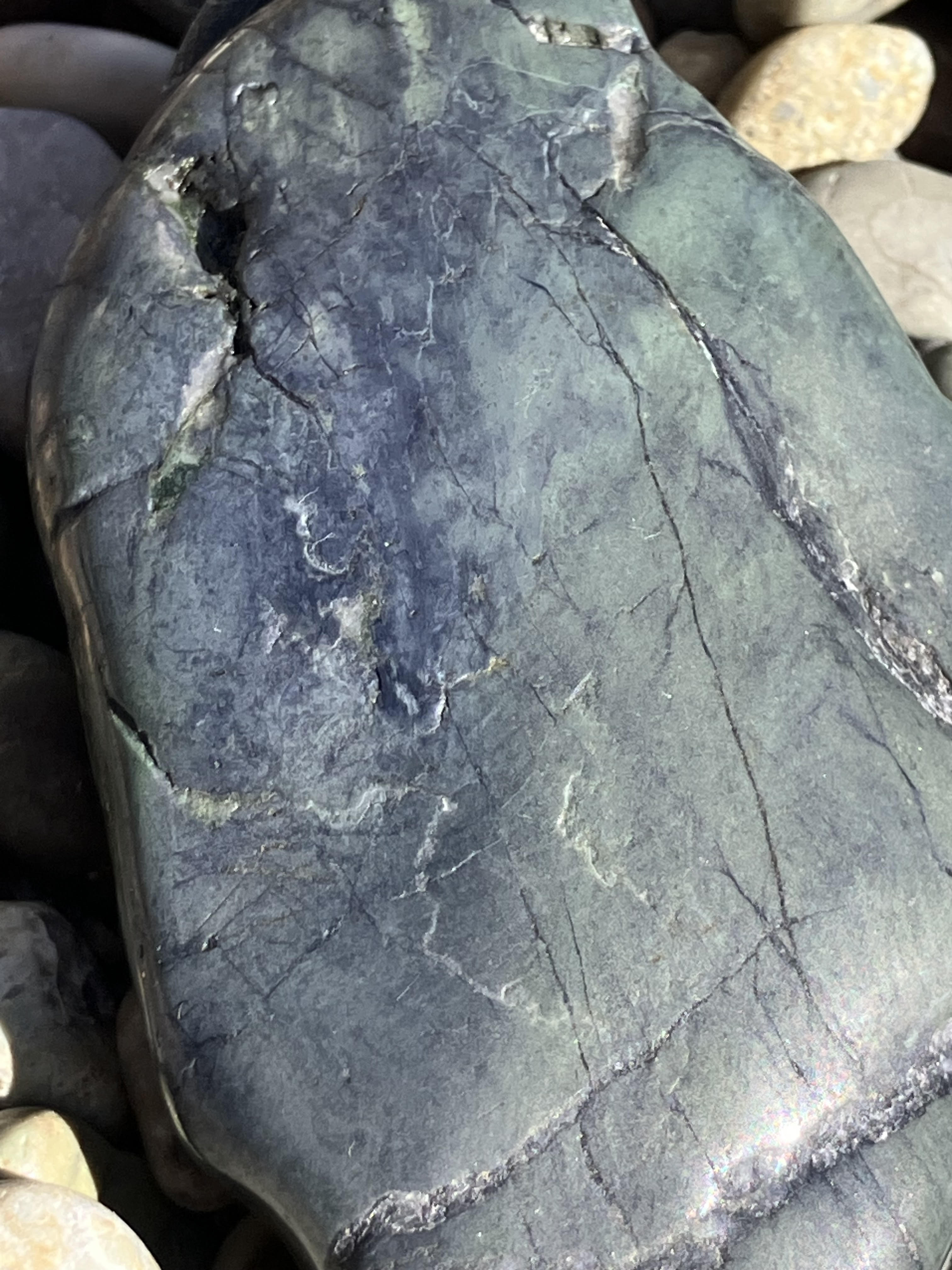
River-worn jade is normally invisible. It carries a weathering rind — tan, brown, rust, sometimes leached and sugary — that hides everything about the interior. Spraying or dipping the stone brings back the color and translucency that a dry, dusty surface suppresses; it is the cheapest way to see what you are actually looking at.
If wetting is not enough, cut a small window on an inconspicuous face with a diamond file or a hand saw, and wet that. Nephrite rinds are typically thin and tan-brown. Burmese jadeite boulders are known for thicker, pitted red-brown skins, sometimes with green “pine flower” patches showing through.
-
Backlight a thin edge
Press a bright single-LED penlight against a thin edge or a chipped corner and look at how light moves through the stone. This is one of the most diagnostic things you can do with no equipment beyond a torch.
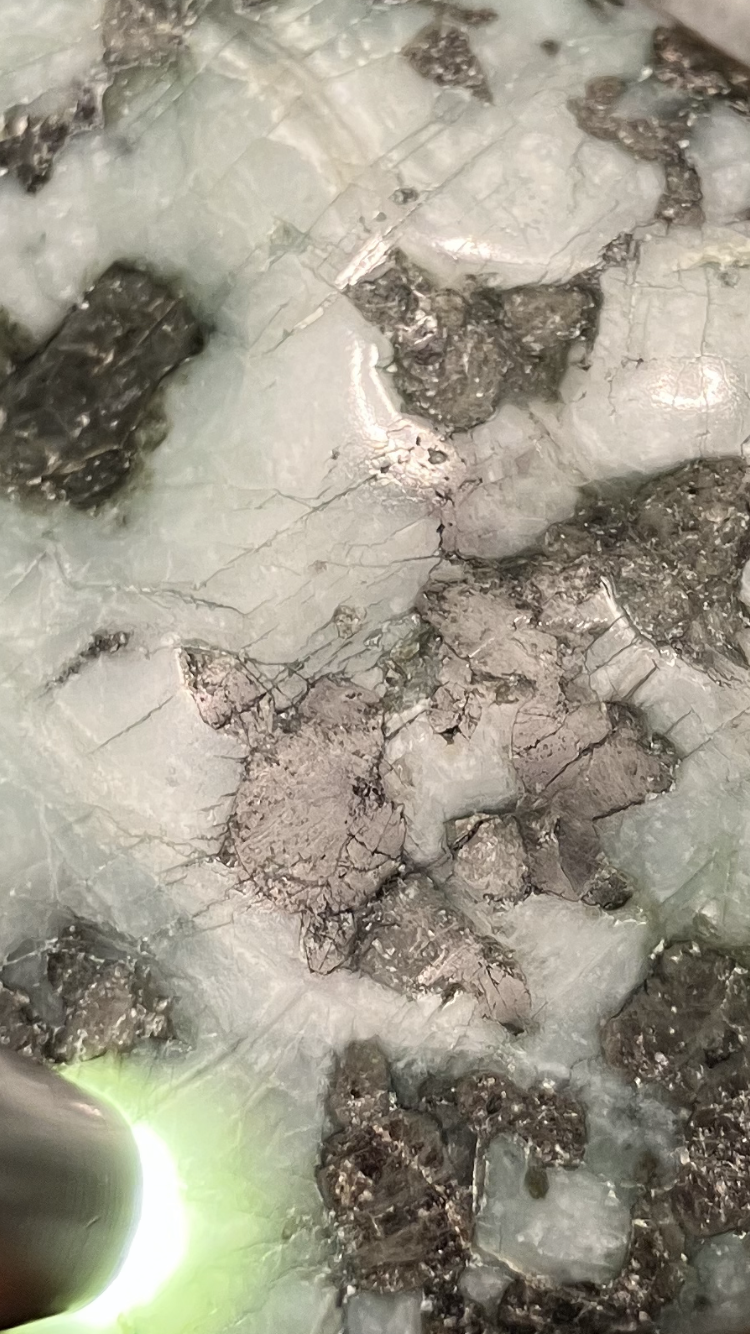
Nephrite’s tangled fibers scatter light: the glow is soft, diffuse and cloudy, often with silky streaks, swirls or cottony patches. Jadeite’s granular aggregate transmits more crisply, and you can frequently see individual grain boundaries and a faint sparkle within the lit zone.
- Nephrite
- Soft diffuse glow; fibrous streaks; milk-glass character.
- Jadeite
- Brighter, crisper transmission; visible granularity; watery in icy material.
-
Hardness against steel
Both jades sit above steel on the Mohs scale — nephrite at 6 to 6.5, jadeite at 6.5 to 7 — so a knife point or a steel nail (about 5 to 5.5) will skid across either without biting. Serpentine and bowenite, the most common false jades, run from 2.5 to 5.5 and will take a scratch readily. That single check removes a large share of impostors.
It does not separate nephrite from jadeite: the half-point between them is not something a hand test can resolve. Streak is no help either — both are white.
-
Read a broken surface under a loupe
A fresh fracture is the clearest window into structure that exists in the field. At 10×, the two jades look genuinely different, and this is where the composition on the previous page becomes something you can see.
Nephrite breaks splintery and fibrous — matted, silky, closer to torn bamboo or felted wool than to a mineral. Jadeite breaks granular, a sugary mosaic of interlocking blocky grains that catch the light individually. Neither produces the clean curved conchoidal fracture of quartz or glass, which is itself a useful exclusion.
- Nephrite
- Splintery, matted fibers; silky sheen on the break.
- Jadeite
- Sugary, granular, glinting interlocked grains.
-
Luster on a polished or water-worn face
Tilt the stone under a light. Nephrite reads greasy — oily, waxy, soapy, a luster that looks like it has been rubbed with fat. Jadeite reads vitreous, glassier and brighter, and often shows a dimpled “orange peel” effect across the surface: because its grains have different orientations, they polish down at different rates and leave a gently undulating face. Seen against a reflected highlight, that dimpling is close to conclusive for jadeite.
-
Look for the accessory minerals
Both jades carry company, and that company is informative. Nephrite commonly hosts magnetite, chromite, epidote, garnet, titanite, serpentine, talc, rutile and diopside — black specks, dark seams and mottling are normal and expected, not defects. Jadeite commonly carries albite, zoisite, garnet, mica, quartz, omphacite and chromite; icy translucent material is frequently a jadeite–albite mixture rather than jadeite alone.
A stone that is uniformly, flawlessly, evenly colored with no internal texture at all deserves more suspicion than a mottled one.
-
Confirm on a bench
Three tests settle it, and the first needs almost nothing.
Hydrostatic specific gravity. A digital scale reading to 0.01 g, a length of thread and a cup of water. Weigh the piece dry (A), weigh it again suspended in water without touching the sides (B), then divide: SG = A ÷ (A − B). Around 2.95 points to nephrite; around 3.34 points to jadeite. Keep the iron-heavy nephrite overlap in mind, and beware included metal or voids skewing the result.
Refractive index. A refractometer spot reading gives about 1.61 for nephrite and about 1.66 for jadeite — a clean separation.
Raman or FTIR spectroscopy. Non-destructive, definitive, and the only method that identifies the specific minerals present and detects polymer impregnation. For anything of real value, this is the answer.
A Chelsea filter is sometimes recommended for jade. It gives false readings in both directions and should not be treated as evidence of anything.
Practical
What to carry
Everything here fits in a jacket pocket except the scale, and the scale is what turns a guess into a number.
- 10× loupe — for fracture surfaces, dye in cracks and grain boundaries.
- Bright single-LED penlight — the backlighting test lives or dies on a hard, concentrated beam.
- Spray bottle of water — restores color and translucency on dry, dusty and rind-covered stone.
- Steel point or hardness picks — a knife tip works; picks at 5.5 and 6.5 work better.
- Small hammer — for the ring test, and for taking a corner off when you need a fresh break.
- Diamond file or small hand saw — for cutting a window through a weathering rind.
- Digital scale to 0.01 g, thread and a cup — hydrostatic specific gravity at camp, from the tailgate.
- Notebook and GPS — record where each stone came from. Locality is evidence, and it is the one piece of evidence that cannot be recovered later.
Exclusions
The lookalikes
Most stones presented as jade are one of these. Several carry trade names built specifically to encourage the confusion — “new jade,” “Transvaal jade,” “Australian jade,” “Indian jade,” “Malaysia jade.” None of them is jade.
| Material | Hardness & SG | What gives it away |
|---|---|---|
| Serpentine, bowenite “new jade,” “Korean jade” |
2.5–5.5 · 2.44–2.62 | By far the most common false jade. Takes a steel scratch easily, feels light in the hand, knocks dully instead of ringing. |
| Vesuvianite / idocrase “californite” |
6–7 · 3.32–3.43 | The genuinely difficult one — hardness and density both sit on top of jadeite. Needs a refractometer or Raman. |
| Hydrogrossular garnet “Transvaal jade” |
6–7 · 3.36–3.55 | Granular like jadeite and similarly dense; usually betrayed by black chromite specks and a slightly bluish-green cast. |
| Prehnite | 6–6.5 · 2.80–2.95 | Radiating fibrous internal structure under backlight, and a distinctive oily yellow-green. |
| Chrysoprase “Australian jade” |
6.5–7 · ~2.60 | A chalcedony: breaks with clean conchoidal fracture, and the apple green is unusually even. |
| Aventurine quartz “Indian jade” |
7 · 2.64–2.69 | Visible glittering mica platelets, and it feels light. |
| Dyed quartzite “Malaysia jade” |
7 · ~2.65 | At 10× the dye sits in the grain boundaries as a network rather than coloring the grains themselves. |
| Maw-sit-sit | ~6 · 2.45–3.15 | A genuine kosmochlor-rich rock from Myanmar, related to the jadeite family but not jadeite: vivid green with black veining. |
| Glass | 5–6 · 2.4–4.5 | Look for gas bubbles, mold seams, swirl marks and conchoidal fracture. Warms quickly against the skin; jade stays cold. |
A-jade
Natural. Nothing done to it beyond cutting, polishing and, traditionally, a surface wax. Color and transparency are entirely the stone’s own. It rings properly when tapped.
B-jade
Acid-bleached to strip brown iron staining, then vacuum-impregnated with polymer resin to restore the transparency the acid destroyed. The structure is permanently damaged. Under a loupe the surface shows an etched, cobweb-like network of channels where the acid ate along grain boundaries; the stone often looks unnaturally, evenly bright; and it thuds instead of ringing because resin damps the vibration. FTIR shows the polymer outright. B-jade yellows and degrades with age, heat and sunlight.
C-jade
Dyed. The tell is where the color sits: at 10×, dye pools in fissures and along grain boundaries in a fine network, rather than residing within the grains as natural color does. Green dyes are common; lavender and orange dyes also circulate.
B+C jade
Bleached, impregnated and dyed. Both sets of indicators apply. Nephrite is treated as well — dyed black nephrite exists, and dyed green serpentine is routinely sold as nephrite.
Buying
A, B and C
The trade grades jade by what has been done to it, not by quality. The letters describe treatment, and they matter more to value than color does.
For any stone worth real money, a report from an independent laboratory is the only reliable answer — and the seller should not hesitate to let you get one.
One last thing
Know the ground, not just the stone
Before collecting anywhere: check who owns the ground and who owns the mineral rights, because they are frequently not the same party. Claims, leases, park boundaries, tribal land and streambed regulations all apply to jade, and in several well-known jade districts they are actively enforced.
Ask where a stone came from, and say where yours came from. Locality is the one property no test can recover after the fact — and it is the part of a stone’s description most often left vague.